
Table of Contents
How to Write a Standout Motivational Letter for Bursaries 2026
Applying for a bursary in South Africa is competitive — thousands chase the same spots for 2026 intake. Your motivational letter (also called motivation letter or motivation essay) is often the deciding factor. It shows who you are beyond marks: your drive, need, goals, and fit for the bursary.
A strong letter can turn “good applicant” into “must-fund student.” Many providers (e.g., Sasol, Standard Bank, Funza Lushaka) read hundreds — yours needs to stand out honestly and clearly.
Why the Motivational Letter Matters in 2026
This is Why the Motivational Letter Matters
- Bursary committees want to invest in future leaders who will give back to SA.
- It explains financial need without sounding desperate.
- It proves passion for your field (e.g., engineering innovation, teaching rural communities).
- Poor letters get rejected fast — spelling errors, generic text, or no personal story.
Keep it 400–800 words (1–2 pages), typed, PDF format unless specified.
Standard Structure: 4–5 Paragraphs That Work
Follow this proven format — simple, professional, and effective for most SA bursaries.
- Header & Salutation Your details (name, address, email, phone, date) at top. Address to: “Dear Bursary Selection Committee,” or specific name if known (e.g., “Dear Funza Lushaka Committee”). Subject line: “Application for [Bursary Name] 2026 – [Your Full Name]”
- Introduction (Paragraph 1: Hook & Purpose) Introduce yourself briefly (current grade/year, institution, field). State the bursary and why you’re applying. Hook with a personal fact or goal. Example opener: “As a matriculant from Limpopo passionate about sustainable agriculture, I am applying for the [Bursary Name] 2026 to pursue BSc Agriculture at Stellenbosch University.”
- Body Paragraph 2: Your Background & Need Explain financial situation honestly (family income challenges, single parent, rural location). Highlight academic strengths (marks, awards) and extracurriculars (leadership, volunteering). Show resilience — e.g., how you’ve overcome obstacles.
- Body Paragraph 3: Goals & Fit Detail career dreams and how the degree helps (e.g., “become a chartered accountant to support SMEs in townships”). Explain why this bursary/provider: Mention their values (e.g., Sasol’s innovation focus, Funza’s education impact). Commit to giving back (community service, work-back if required).
- Conclusion (Paragraph 4–5: Thank & Close) Reaffirm enthusiasm and readiness. Thank them for considering. Provide contact info. Sign off: “Yours sincerely,” followed by full name.
Quick Checklist: Must-Haves for a Standout Letter
- Be honest — no exaggeration.
- Tailor to the bursary (research provider’s mission).
- Use simple, clear English (no slang).
- Proofread 3x (or ask teacher/family).
- Format professionally: Font Arial/Calibri 11–12, 1.5 spacing.
Common Mistakes to Avoid
- Generic copy-paste (sounds robotic).
- Focusing only on need (balance with strengths/goals).
- Too long/short or poor grammar.
- Forgetting to mention the specific bursary/field.
- Negative tone (complaints about hardship) — stay positive.
See our full guide: Mistakes to Avoid When Applying for a Bursary.
Sample Motivational Letter 1: General (e.g., for Engineering Bursary)
[Your Name] [Your Address] [City, Postal Code] [Email] [Phone] [Date]Bursary Selection Committee [Sponsor Name, e.g., Sasol Bursary Programme] [Address]
Dear Bursary Selection Committee,
I am [Your Name], a Grade 12 learner at [School Name] in Gauteng, achieving 82% in Mathematics and Physical Sciences. I am applying for the Sasol Bursary 2026 to study Chemical Engineering at the University of Pretoria.
Growing up in a township where unemployment is high, my family relies on my mother’s small income. Despite challenges like load-shedding affecting study time, I maintained top marks and volunteered at community clean-ups. This bursary would remove financial barriers, allowing me to focus fully on studies.
My dream is to become an engineer developing green energy solutions for South Africa. Sasol’s commitment to innovation inspires me — I want to contribute to sustainable projects post-graduation.
I am committed, hardworking, and eager to give back. Thank you for considering my application. I look forward to your positive response.
Yours sincerely, [Your Name]
Sample Motivational Letter 2: Teaching/Education Focus (e.g., Funza Lushaka)
[Your Name] [Address] [Email/Phone] [Date]Funza Lushaka Bursary Committee Department of Basic Education
Dear Committee Members,
My name is [Your Name], currently in my first year of BEd at [University], specialising in Foundation Phase Teaching. I apply for Funza Lushaka Bursary 2026 to continue my studies and fulfil my calling to educate young minds in rural KwaZulu-Natal.
From a low-income family, I’ve seen how quality teachers change lives — my own primary teacher inspired me despite resource shortages. With strong academics (average 78%) and experience tutoring peers, I am dedicated to returning to underserved areas after graduation.
This bursary covers tuition and living costs, freeing me to excel. In return, I pledge to teach in public schools as required, building brighter futures for SA children.
Thank you for investing in education. I am ready to make an impact.
Kind regards, [Your Name]
Download Sample Motivational Letter for a Bursary Application
Download Sample Motivational Letter for a Bursary Application

Tips to Make Yours Even Stronger
- Personalise: Reference specific bursary details (e.g., “your support for black female engineers”).
- Show impact: How will you contribute to SA?
- Get feedback: Share draft with mentor.
- Save as PDF named: “Motivational_Letter_[YourName]_2026.pdf”
- Use AI to make it water tight.
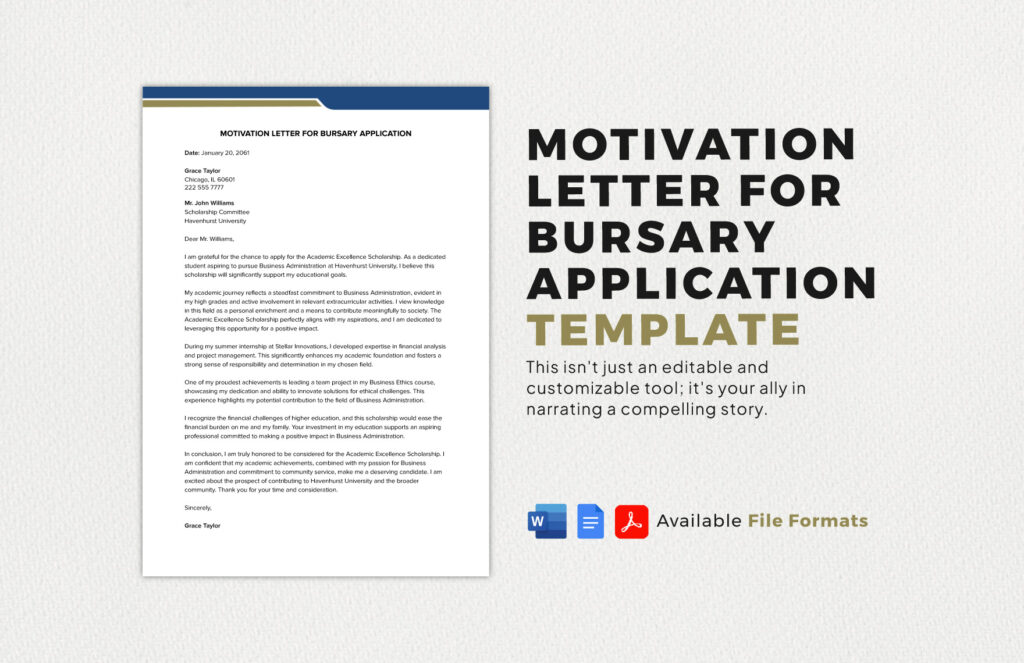
Download Sample Motivational Letter for a Bursary Application
FAQ
- How long should it be? 400–800 words max.
- Can I use templates? Yes — but customise heavily.
- Do all bursaries require one? Most do; check requirements.
- What if English isn’t my first language? Write simply; get proofreading help.
Ready to craft yours? Subscribe for more 2026 application guides, or contact us with questions — we can review tips for your field!
Explore related: Accounting Bursaries | NSFAS vs Private Bursaries | More Resources
Your story matters — write it powerfully! 🚀